
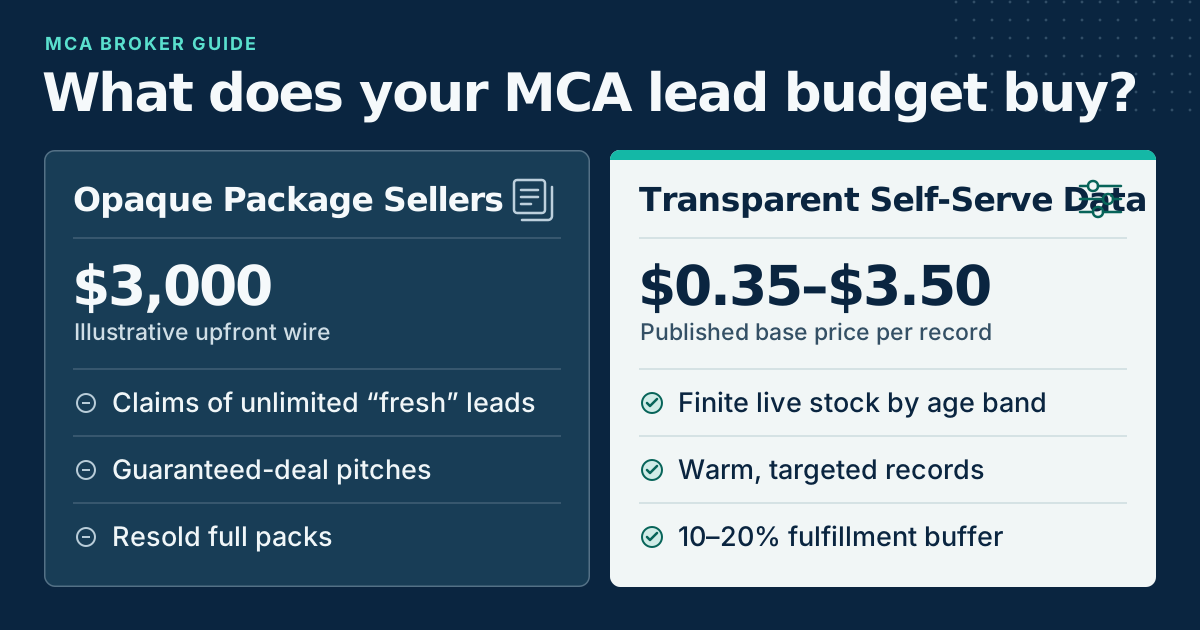
You wired a few thousand dollars for a “guaranteed full package.” Your closers worked the phones all week. Friday’s report shows zero funded deals, and the owner has a fair question: did the reps miss, or did somebody sell you the same merchants your floor called last month?
Before you buy another file, pull three things: the seller’s definition of fresh, the call dispositions and the applications that actually reached underwriting. Each answers a different part of that question.
Quick answer for a desk deciding whether to buy
- A recycled application can arrive in a brand-new file. An unclear inquiry date, repeated resale and no allocation cap can exhaust a merchant before your first dial.
- Finding merchants and closing their deals take different people and capital. A generator can sell useful records while reserving part of its business for returning floors or trusted revenue-share partners.
- Run ads when someone can own acquisition, qualification and the learning budget. Buy one age band when you have reps ready to work it and need to test a source at a known cost.
- You can compare Lead Slaps’ published prices and allocation rules before spending anything. Base prices run $0.35–$3.50 per record, the normal cart minimum is $100 before discounts, and there’s no contract.
Why a “fresh” MCA lead package can be worn out on arrival
Ask what happened on the date stamped on the file. Was that when the merchant asked about funding, when a broker received documents, or when somebody exported the CRM? All three can happen on different dates. A file delivered this morning can contain a request the owner settled months ago. A rep opening with “calling about your request today” starts that conversation in a hole.
“Full pack” can be just as slippery. A spreadsheet row showing average deposits is different from a bank statement the merchant supplied. Even a genuine February statement answers a February question. If the rep promises terms off that paperwork and underwriting asks for current statements, the merchant has to start again. Agree on which documents are included, their dates and what the merchant still needs to provide.
Consider an illustrative resale chain. A seller distributes a pack ten times and another ten desks get copies downstream. Your rep can be making a perfectly good first call to an owner who has already explained the same deposit several times. One irritated merchant proves little. A cluster of owners remembering the same pitch, alongside matches in your own CRM, gives you something concrete to investigate.
The wire is where skepticism pays. Imagine being quoted $1,500 to test, $3,000 to unlock the “better” batch, or 20,000 fresh records every week regardless of demand. Those are examples of pitches, not market averages. Ask for the age band, allocation and price of the next order in writing. If the quote changes the moment you report a close, your first batch cannot tell you what scaling will cost.
A public event can also be packaged as recent demand. If the seller dates an inquiry from a lien filing, our guide to what a UCC filing tells an MCA broker explains why those dates can differ. For broader diligence, use the questions to ask before buying MCA leads while you still have the option to walk away.
If the data is good, why would anyone sell it?
A generator has to win attention, capture the inquiry, maintain the records and decide who gets access to them. A closing floor has to reach the owner, collect statements, find a funder that fits, negotiate an offer and see the deal through funding. Put a good media buyer in charge of twenty closers tomorrow and you’ve handed them an entirely different business.
There’s also a fair point behind the suspicion. An operator with finite supply has a reason to prioritize a returning floor that pays predictably and reports what happened. A private RevShare arrangement can make sense when a generator trusts a shop to work every assigned record and report funded deals accurately. A brand-new buyer has earned neither that trust nor first call on somebody’s whole book.
Useful inventory can still reach a self-serve buyer. A three-rep ISO might want one week’s work in an older band that a returning shop has no capacity to cover. The buyer needs to know what’s available and how it’s allocated. At Lead Slaps, a record is offered in one band at a time. Direct Submissions close after one buyer. Alpha Triggers have caps per age band. You can make a small purchase without negotiating a five-figure monthly commitment.
Should an MCA broker buy leads or run Meta and Google ads?
If you routinely lose deals because inquiries fall outside your funders’ credit boxes, owning the form can be valuable. Ask about time in business, recent revenue and the use of funds before tying up a closer. Then review the answers against what qualified merchants actually send. A form that asks for little more than a name and number makes it easy for a pre-revenue startup to look like an established shop.
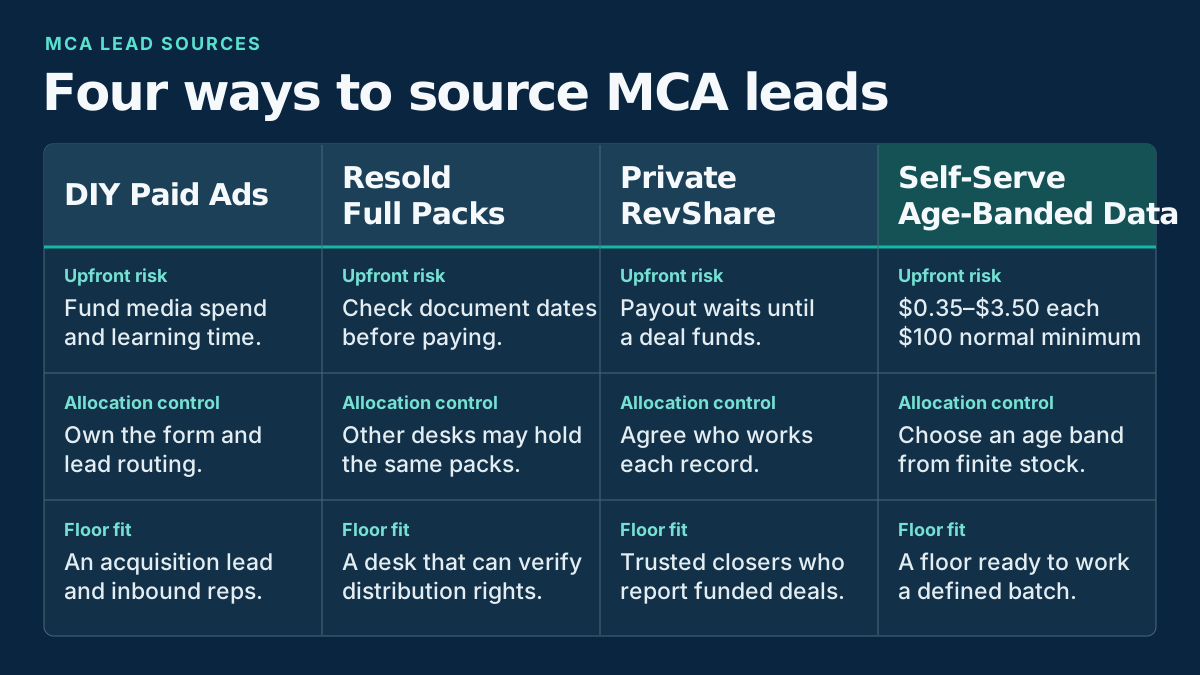
| Source | What you control | What you carry | Best fit |
|---|---|---|---|
| In-house Meta or Google ads | Ad, landing page, questions and routing | Creative, media spend, low-fit inquiries and time to learn | A team with an acquisition owner and prompt inbound coverage |
| Resold application packs | What you inspect and accept before paying | Uncertain overlap and potentially stale documents | A desk able to verify dates, rights and distribution history |
| Private RevShare | Terms both parties agree on and outcomes they reconcile | Delayed compensation and reliance on accurate reporting | Established partners with a track record together |
| Self-serve age-banded data | Tier, available quantity, age band and initial spend | Rep time, follow-up and underwriting fit | A solo ISO or staffed desk able to work a defined batch |
An in-house test can absorb thousands of dollars in a month while a buyer learns which creative attracts fundable businesses. Treat that as a possible planning scenario. There’s no universal spend threshold. Agree on how much you can spend before a single deal funds, who reads the declines and who can change the campaign. Google’s distinction between qualified leads and converted leads is useful when deciding which CRM outcomes to send back to the ad account.
For a one-to-ten-rep shop with a spare calling block tomorrow, buying MCA leads by age band gives you a smaller decision. A volume floor can do both: staff inbound inquiries when they arrive and work purchased records in scheduled outbound blocks. Keep the sources separate in the CRM. Otherwise an expensive inbound campaign can get credit for a deal your outbound rep had been working for weeks.
Where to buy MCA leads: five signals you can check before paying
| Signal | A package pitch leaves you guessing | What you can check at Lead Slaps |
|---|---|---|
| Stock and availability | The answer is always “unlimited fresh,” whatever quantity you request. | Check live quantities by band. Pulse Data is marked currently unavailable in the builder. |
| Expectations | The pitch promises deals from a spreadsheet. | We describe the records as warm and targeted. The merchant’s current need, timing and fit still require a conversation. |
| Imperfect records | The quote assumes every contact still works. | We include 10–20% extra buffer records in orders to absorb bad numbers and outdated contacts. |
| Pricing and allocation | An upfront wire secures an unspecified pack. The next quote depends on what you tell the seller you closed. | Published base rates are $0.35–$3.50, with a normal $100 pre-discount minimum. Direct goes to one buyer and closes. Alpha allocation is capped by age band. |
| Pre-dial preparation | Reps receive rows with no way to tell what has been checked or which documents come with them. | The add-on eligibility guide lists TrustDial phone verification and trust scoring at $0.20 per eligible Alpha record, and StatementSnap bank statements at $10 per eligible fresh Direct record. |
Put one $100 test on your own dialer
Choose warm, targeted Direct Submissions at $0.75–$3.50 across 0–180 days for single-buyer allocation, or Alpha Triggers at $0.35–$0.55 across 1–12 months with caps by age band. Our fulfillment team includes 10–20% extra records as a buffer for bad contacts. Budget from the quantities and prices in your cart.
The normal minimum is $100 before discounts, including add-ons. A smaller cart qualifies when you take all remaining inventory in every selected age band and the final payment is at least $0.50. Direct starts at 25 records per configuration, or all remaining records in that band if fewer than 25 remain.
You can configure a test order against live stock without a contract, subscription or setup fee. If you’re choosing between tiers, compare the published base prices first. We deliver by email within two business hours. Payments confirmed after 7 p.m. Eastern are delivered the next business morning.
When aged, targeted records give the floor a better shot
An owner who took funding last month may have had nothing to discuss the day the deal closed. Months later, a seasonal inventory buy can give that same owner a reason to talk. Start by asking what changed. An older inquiry gives you context for that question. It gives you no basis for telling the merchant they are due for a renewal.
On Direct Submissions, the under-15-day band costs $3.50 and the 15–30-day band costs $2.75. Both are eligible for StatementSnap. Older Direct records cost $1.00 at 30–90 days and $0.75 at 90–180 days. For a broader reactivation run, compare the three Alpha Triggers bands: $0.55 at 1–3 months, $0.45 at 4–6 months and $0.35 at 7–12 months. FundSense, the $0.40 AI score, is retained only on eligible existing orders.
An unanswered call from a rep’s cell tells you very little. A trained rep needs a usable dialer, a relevant opener, a permitted follow-up channel and a place to record the next action. Use the aged-lead opening and follow-up scripts to give reps a consistent starting point. Check channel permission and suppression separately, using the TCPA guide for MCA brokers when planning outreach. Phone verification serves a different purpose.
A four-step $100–$250 test before you buy more
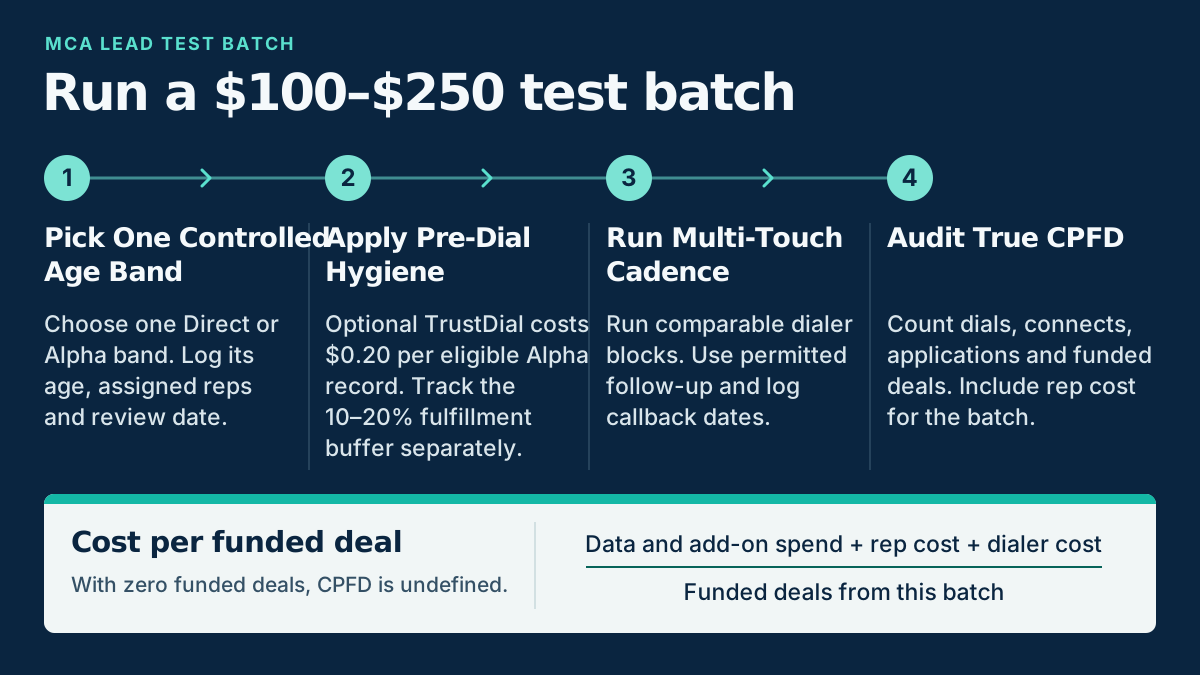
- Buy one band and name the comparison. Write down the source, inquiry age, assigned reps and review date before importing. Illustrative order: 300 Alpha records aged 7–12 months at $0.35 cost $105. Optional TrustDial adds $60, bringing the base subtotal to $165 before eligible discounts. The fulfillment buffer is separate from those paid line items.
- Clean the batch before allocating seats. Match against existing accounts, open opportunities and suppression records. Separate unusable numbers, duplicate entries and merchants already talking to your floor. Keep counts for what arrived and what was callable. Quietly dropping every bad row before reporting makes a weak source look better than it performed.
- Run comparable call blocks. Give the test and comparison groups similar reps, hours and follow-up opportunities. Log dials, right-party connects, applications received and funded deals separately. A rushed rep can make five attempts to one merchant. That’s five dials, one record and at most one new conversation. Record callback dates so the next shift can finish the work.
- Price the result before scaling. Add actual data and add-on spend to the rep time and dialer cost attributable to the batch. Divide by funded deals from that batch. With zero funded deals, CPFD is undefined. Report spend and open applications, then revisit on the agreed date. Use the aged-lead ROI breakdown to cost rep time, or the exclusive-versus-shared CPFD model to compare allocation options.
Read the drop-off before authorizing another order. Plenty of right-party connects and no applications? Listen to the opener and check underwriting fit. Applications arriving but dying at stip collection? Review the handoff with the closer. A file full of disconnected lines calls for a different conversation. One funded deal can justify a second controlled batch. It takes repeatable economics to justify staffing another seat.
Where private RevShare fits
A revenue split gives the generator a stake in what funds. It also leaves them relying on the shop to record outcomes, reconcile commissions and pay as agreed. We don’t offer cold RevShare through the builder or off the back of an introduction. A transparent self-serve order gives both sides a starting point.
An established floor that consistently works the data and can show funded outcomes can discuss an ongoing data relationship with our team. Bring a batch history, how your team handled follow-up and the volume you can actually work. That makes a conversation about recurring allocation or performance alignment worth having.
Frequently asked questions
Why do so many bought MCA leads feel like garbage?
A recent delivery can contain old inquiries, widely resold applications or phone numbers that have changed hands. Compare the original inquiry date, duplicates in your CRM and right-party conversations before deciding whether the file or the floor needs work.
If a provider has good MCA data, why sell it instead of funding deals themselves?
Generating demand and running a closing floor require different staff, skills and capital. An operator can serve returning volume shops or private partners while selling finite, age-banded inventory to desks that want a smaller test.
Should an MCA broker buy leads or run their own Meta and Google ads?
Run ads if someone owns the campaign, can qualify applicants and has enough budget to learn from unsuccessful spend. Buy a controlled batch if your immediate advantage is a staffed phone team. A shop doing both should track each source through funding separately.
Are bought MCA leads “hot” or ready to close on the first call?
We describe Lead Slaps records as warm and targeted. Previous funding interest gives the rep a reason to ask about the business. The merchant still decides whether there is a current need and whether to pursue an offer.
How does Lead Slaps handle bad numbers or outdated records in an order?
We include 10–20% extra buffer records in orders to absorb inevitable bad contacts. That buffer is a fulfillment practice. Your checkout quantity and line-item prices are the basis for your purchase.
Can I test Lead Slaps without a monthly contract or large upfront wire?
Yes. The normal cart minimum is $100 before discounts, including add-ons, with no contract, subscription or setup fee. A smaller order qualifies if it takes all remaining stock in every selected band and meets the $0.50 payment minimum.