
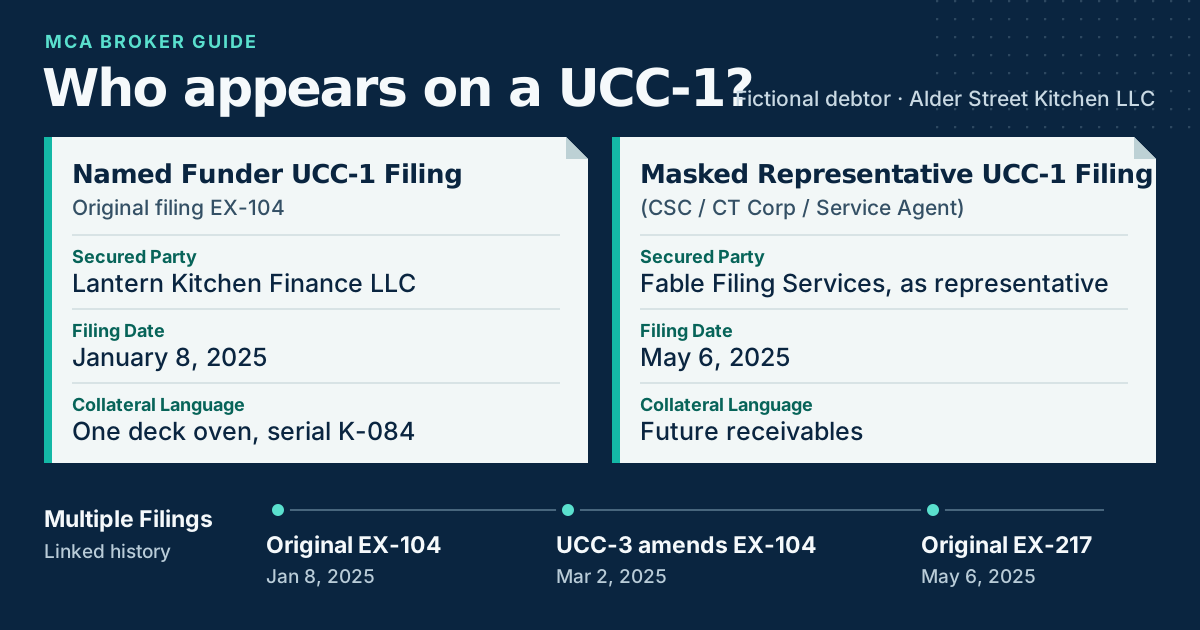
A Monday UCC pull shows two filings against the same restaurant. Before your rep writes “just funded, two open positions” in the CRM, open both documents. One might cover the ovens, and the other might name a representative for a receivables deal the owner paid off last quarter.
What a broker can tell at a glance
- A UCC-1 gives public notice of a possible interest in collateral. Read the debtor name, secured party and collateral description together.
- A representative can appear in the secured-party field. The underlying funder’s brand and the merchant’s current balance can both be absent.
- A fresh filing gives every shop watching that index the same reason to call. It tells you nothing about whether the owner wants another offer.
- If filing research is eating into call time, compare lead types and age-band prices. Alpha Triggers start at $0.35 per record for the 7–12 month band.
How to read a UCC-1 before you call the merchant
Start with the legal entity on the application. A restaurant’s sign, the LLC that operates it and the company that owns the building can have three different names. Confirm the entity and its state of organization before searching. For an ordinary registered business, the state of organization is generally where you start. A search confined to the storefront’s state can miss the record you need.
Use the filing office’s debtor-name search, then open each original financing statement and its linked history by file number. Save the jurisdiction, file number and date searched. That gives underwriting a way to reproduce your work when a merchant changes its name or a new amendment appears. The New York Department of State UCC search and filing guide offers three ways in: debtor, filing number or secured party.
| Read this | What to put in the deal notes | What still needs checking |
|---|---|---|
| Debtor name and jurisdiction | Exact entity and filing office searched | Does the entity match the applicant and bank account? |
| Secured party | Name as filed, including any representative designation | Which counterparty signed the merchant’s agreement? |
| Collateral | Equipment, receivables or broader asset language, with any exclusions | Does it overlap the receivables involved in this deal? |
| File number and history | Original date plus linked amendments, continuations and terminations | Which filing does each later document affect? |
Filing habits vary. A funder may file promptly to put later funders on notice and discourage stacking, reserve filings for larger exposures, or file later when a deal runs into trouble. Some advances may have no corresponding public filing. Under Washington’s enacted Article 9, an authorized filing can precede the security agreement. A filing date alone establishes neither a funding date nor a default.
Masked filings and blanket liens answer different questions
Masked describes whose name you see. Blanket describes the breadth of the collateral indicated. You can have both on the same UCC-1. A named bank can also file against a single piece of equipment. Start with those two distinctions before classifying a filing as an MCA.
Why CSC or CT Corp can appear on an MCA filing
The secured party can use a representative. That arrangement lets the representative handle filings while the client’s name stays off the public form. Read the box label carefully. A service company in the “return acknowledgment to” box may simply have submitted the document. Its name in the secured-party box carries a different meaning. In this Oregon Secretary of State filing, the secured-party field reads “C T Corporation System, as representative.”
To find masked UCC filings, search under the debtor’s legal name first. Searching for the suspected funder misses records filed under a representative. If a merchant obtained working capital through a software platform, a bank-originated agreement can also carry a bank name the merchant never mentioned. Ask for the agreement and match its legal counterparty to the funding deposit or remittance paperwork.
Collateral language such as “future receivables” gives you a reason to ask how receipts are collected. It cannot identify a particular funder. Two filings close together under the same representative warrant a look at each file number, debtor and collateral description. The representative may act for different clients, and identical boilerplate tells you little about who actually sent the money.
What a blanket lien means for a second position
“All assets” is a broad indication on a financing statement. Compare it with a filing limited to a named truck or oven. A funder reviewing a second-position MCA needs to know whether its proposed receivables overlap the existing claim. The signed agreements, any restrictions on additional funding and the existing funder’s requirements belong in that review.
A blanket filing can discourage another advance. It does not itself settle lien priority or prohibit every later transaction. If the merchant says the old funder approved another position, ask for the written approval. A CRM note saying “first is fine with it” gives the next underwriter nothing to check.
Fresh vs. expiring UCC filings for MCA outreach
A filing enters a public index once, but the same entry can surface on several dialer floors. A debt-settlement firm watching that index can call about the same event with an entirely different pitch. From the owner’s side, every caller seems to know something about the business, and every caller wants an explanation. Another “I see you just took funding” opener gives the owner a good reason to hang up.
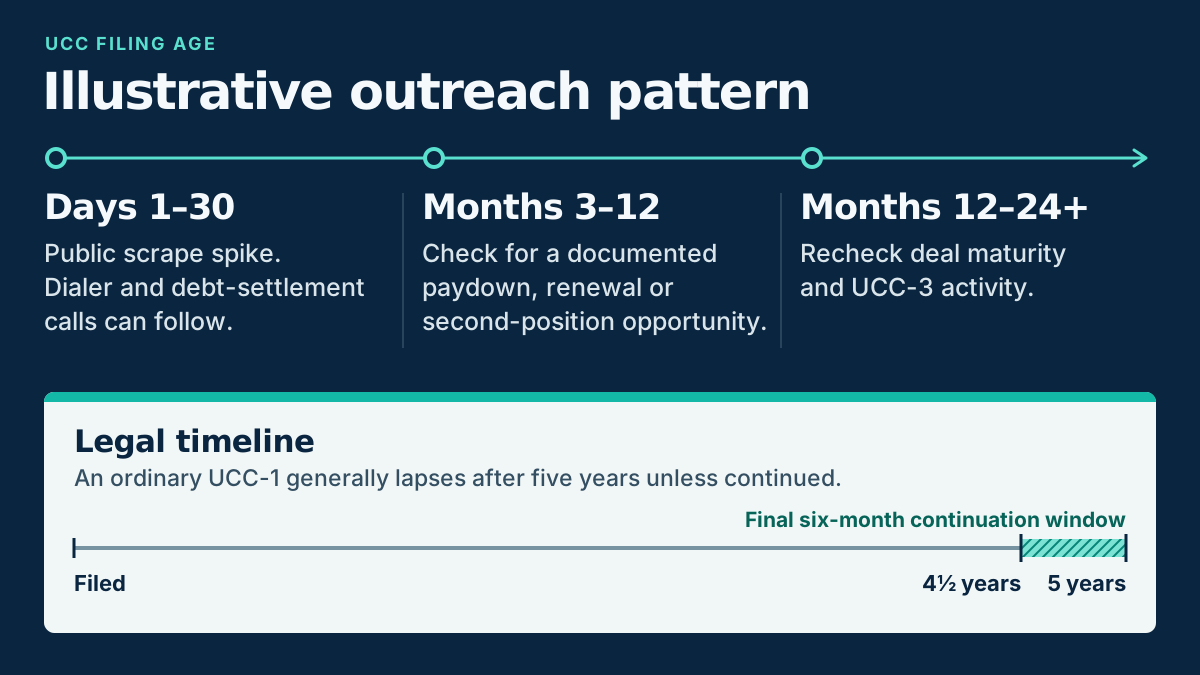
The timeline illustrates how calls can bunch up when shops buy the same fresh feed. Call volume and conversion by filing age have no measured benchmark here. Before outreach, use the TCPA compliance guide for MCA brokers to check permission for the channel, then review prior interactions and your suppression list. Honor a STOP reply. Finding the number again on tomorrow’s list changes nothing about the merchant’s request.
Keep two dates in your notes. One is the merchant’s deal review date, supported by current remittances, an agreement or a callback the owner requested. The other is the public filing’s lapse date. An ordinary UCC-1 generally runs five years, with a continuation permitted in the final six months. A deal can pay down within months while its financing statement stays on file for years.
A UCC-3 can amend, assign, continue or terminate an earlier filing. Open it and read the action selected. An assignment can explain a change in payee. A continuation keeps the filing effective. A termination tied to the correct original filing deserves a place in the file, alongside separate confirmation of payoff if your deal depends on it. None of these dates tells you the owner is shopping today.
Raw MCA UCC leads vs. age-banded lead data
| Source | Best for | Competition / burnout | Allocation / exclusivity | Pricing | Main catch |
|---|---|---|---|---|---|
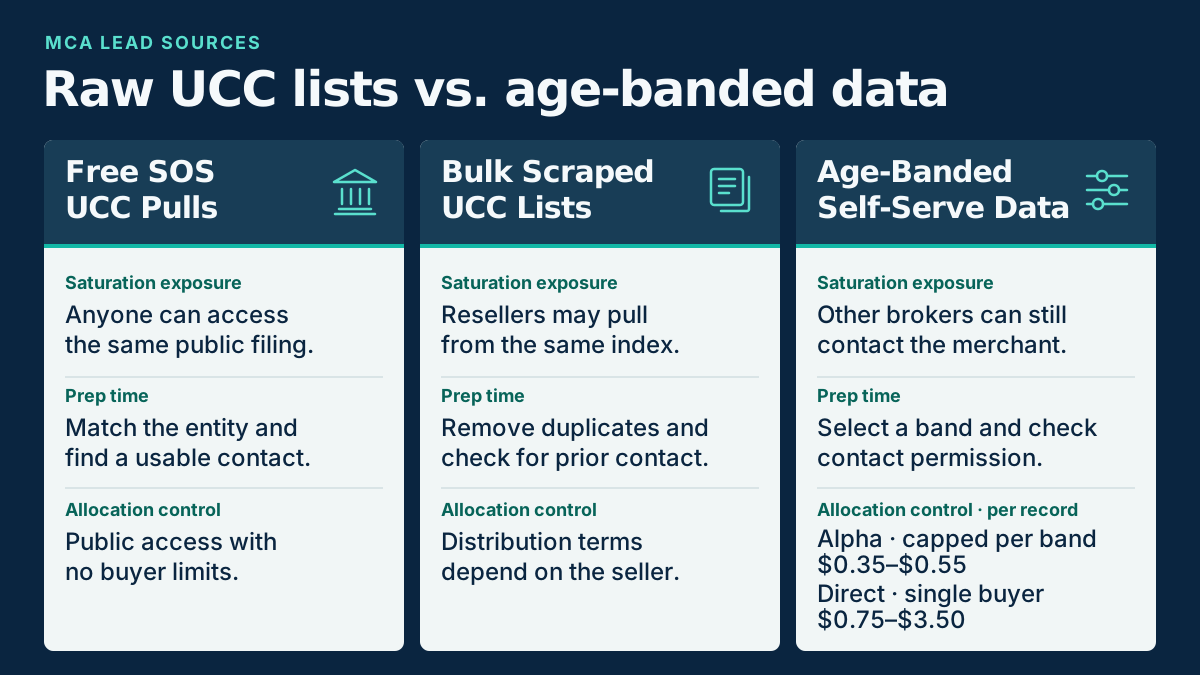
| Free Secretary of State manual UCC pulls | Checking a known entity or researching a short list | Anyone with access can research the same filing | Public record, no buyer allocation | Free lookup where offered. Copies or certified searches may cost extra. | Rep time goes into matching the entity, reading amendments and finding a usable contact. |
| Bulk scraped or resold public UCC lists | Screening public filing activity across many entities | Different sellers can draw on the same index | Public source. Distribution terms depend on the seller. | Seller-specific | A new list delivery can contain an old filing or a merchant you already suppressed. |
| Lead Slaps Alpha Triggers | Working funding-interest records in a selected 1–12 month band | Other outreach to the merchant is possible | Capped per age band | $0.35–$0.55 per record. Optional TrustDial adds $0.20. | Record age gives no payoff date or confirmed callback permission. |
| Lead Slaps Direct Submissions | Working applicant records aged 0–180 days | Single-buyer allocation limits overlap from this sale | Sold to one buyer, then closed | $0.75–$3.50 per record | The owner can still contact another broker independently. |
Choose the age band your reps can work
Alpha Triggers cost $0.55 at 1–3 months, $0.45 at 4–6 months and $0.35 at 7–12 months, with allocation capped per band. For a single-buyer submission, Direct costs $3.50 under 15 days, $2.75 at 15–30 days, $1.00 at 30–90 days and $0.75 at 90–180 days. Each Direct record closes after one buyer.
The cart normally starts at $100 before discounts, including add-ons. There is no contract, subscription or setup fee. See Alpha Triggers pricing by age band · Check available quantities in the builder
For an illustrative order, 300 Alpha records aged 7–12 months cost $105 at base price. Optional TrustDial phone verification and trust scoring adds $60, for $165 before discounts. The add-on eligibility guide lists StatementSnap separately: it adds bank statements for $10 per record on Direct Submissions under 15 days and at 15–30 days. Pulse Data is currently unavailable in the builder.
A smaller cart is possible when it takes all remaining inventory in every selected age band, subject to the $0.50 payment minimum. Direct normally requires 25 records per configuration. If fewer than 25 remain in that band, you can buy all of them. Delivery is by email within two business hours. Payments confirmed after 7 p.m. Eastern are delivered the next business morning.
A broker’s workflow for checking possible stacking
1. Build a position list with the merchant. Ask which advances or credit facilities still collect, who collects them and whether the debit is daily or weekly. Get permission to review recent bank statements. For each obligation, put the merchant’s description beside the deposit, debit descriptor and agreement. Keep an unresolved item open when the owner knows the brand but the bank uses a servicing name.
2. Match cash movement to paperwork. Suppose the account shows three recurring debits but the SOS search returns one filing. An equipment lease, a tax payment and an MCA can all debit on the same weekday. Trace each debit to its payee before counting positions. Conversely, one withdrawal can come from a processor administering more than one obligation. Ask what the remittance covers, then use the broker pre-underwriting checklist to reconcile the statements with the application.
3. Document what the next deal would do. For a proposed first position, resolve competing claims on the same receipts. For a proposed second, show what cash remains after the first remittance and what the existing agreement permits. For a consolidation, get current payoff figures, identify who will be paid at closing and specify what evidence will show that the old withdrawals stopped. A UCC search alone cannot answer any of those questions.
4. Give the rep a next action the owner would recognize. “Owner asked us to call after the equipment payment ends” is a usable note. “Eight-month-old UCC, probably ready” is guesswork. If you test fresh and aged lists, log duplicates, prep hours, conversations and funded deals by source over the same observation period. Include rep time when comparing the return on aged MCA leads and cost per funded deal on exclusive vs. shared leads.
Build a list around your next call block
Choose the age band and allocation that fit the conversations your team is equipped to handle. The builder shows available quantities and pricing before you order.
Configure Your Lead List → · Compare Trigger Leads & Pricing →
This guide is for MCA broker education and does not provide legal advice.
Frequently asked questions
Are free Secretary of State UCC filings good MCA leads?
Free filings are useful for researching a business and checking its financing history. A public record supplies neither a request for funding nor permission to contact the owner. Budget time to match the entity, read the filing history and check whether outreach is appropriate.
Why do MCA UCC filings list CSC or CT Corp instead of the lender?
Article 9 allows a secured party to name a representative on the financing statement. CSC or CT Corp can appear in that role, which can leave the underlying funder unnamed. Check the secured-party field and use the merchant’s agreement to verify the counterparty.
Does a new UCC-1 filing always mean a business just got funded—or defaulted?
No. An authorized filing can precede funding, and a funder’s filing schedule can differ from its disbursement schedule. Verify funding against the agreement and deposit, and check payment history separately before drawing any conclusion about default.
How can an MCA broker spot a stacked merchant from UCC filings?
Look for multiple original filings against the same legal entity with overlapping receivables language. Then match each to an agreement and an active remittance on the bank statements. Different file numbers can cover different assets, and an active obligation can exist without a corresponding filing.
Do fresh UCC filings or older/expiring UCC filings convert better?
Filing age alone cannot predict which group converts better for your desk. Fresh public records can attract competing calls, while an older record can be worth revisiting when the merchant confirms a paydown or renewal date. Compare funded deals and rep time across equivalent groups before shifting budget.
How do age-banded trigger leads differ from raw public UCC lists?
A raw UCC list groups businesses by a public filing event. Lead Slaps Alpha Triggers group funding-interest records into 1–3, 4–6 and 7–12 month bands with capped allocation. An Alpha age band tells you the age of the record and should never be read as the date of a UCC filing.